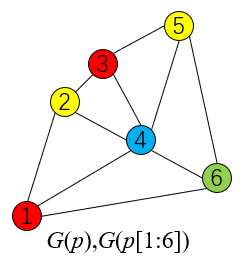
For an $n$-order permutation $p$, we set up an **undirected simple graph** $G(p)$ with $n$ vertices numbered from $1$ to $n$.
We create an edge between each vertice $i$ and the nearest vertices in each side which correspond a greater (or less) $p$ value than $p_i$.
Formally,in this graph, $\forall up_v$, and no $up_i$;
* $p_up_v$, and no $up_v$.
For a segment $[l,r]$, define its **corresponding permutation** $p[l:r]$ as an $(r-l+1)$-order permutation with the same relative orders of elements as $p_l,p_{l+1},\cdots,p_r$; that is, for all $1 \leq i < j \leq r-l+1$, the boolean value $[p_{l-1+i} < p_{l-1+j}]$ is the same as the boolean value $[(p[l:r])_i < (p[l:r])_j]$.
For instance, for the permutation $q=\{1,4,2,5,3\}$, $q[2:4]$ is a permutation of length $3$ with the same relative orders of elements as $\{4,2,5\}$, i.e. $\{2,1,3\}$.
The [chromatic number](https://en.wikipedia.org/wiki/Graph_coloring) of an undirected graph $G$ is the smallest number of colors needed to give each vertex a color such that every edge connects two vertices with different colors. We call this $c(G)$.
Given a permutation $p$ of length $n$, please find the chromatic number of $G(p)$.
Additionally, please answer $q$ queries in the form of $[l,r]$ asking for: the greatest chromatic number among those of all **corresponding permutations** of each subsegment of $[l,r]$, $\mathrm{maxc}$; and the number of subsegment that achieve this maximum number $\mathrm{cnt}$.
(Formally,for each given $l,r$,$\forall l\le l'\le r' \le r$,calculate the maximum possible value of $c(G(p[l':r']))$,called $\mathrm{maxc}$,and $\sum_{l\leqslant l'\leqslant r'\leqslant r}[c(G(p[l':r']))=\mathrm{maxc}]=\mathrm{cnt}$ .)
Input format
The first line contains a positive integer $n$.
The second line contains $n$ positive integers $p_1,p_2,\cdots ,p_n$.
The third line contains an integer $q$.
The following $q$ lines each contains two positive integers $l,r$, denoting a query.
Output Format
Output contains $q+1$ lines in total. The first one should contain a positive integer denoting the chromatic number of $G(p)$, followed by $q$ lines each containing two integers $\mathrm{maxc},\mathrm{cnt}$ for each query.
Sample 1
The following picture describes $G(p)$ and a way of coloring:
Sample 2
Constraints
For all test cases, $1\le n\le 3\times 10^5,0\le q\le 3\times 10^5$.
Detailed constraints are as follows (blank grids denote the same constraints as mentioned above):
 LibreOJ